
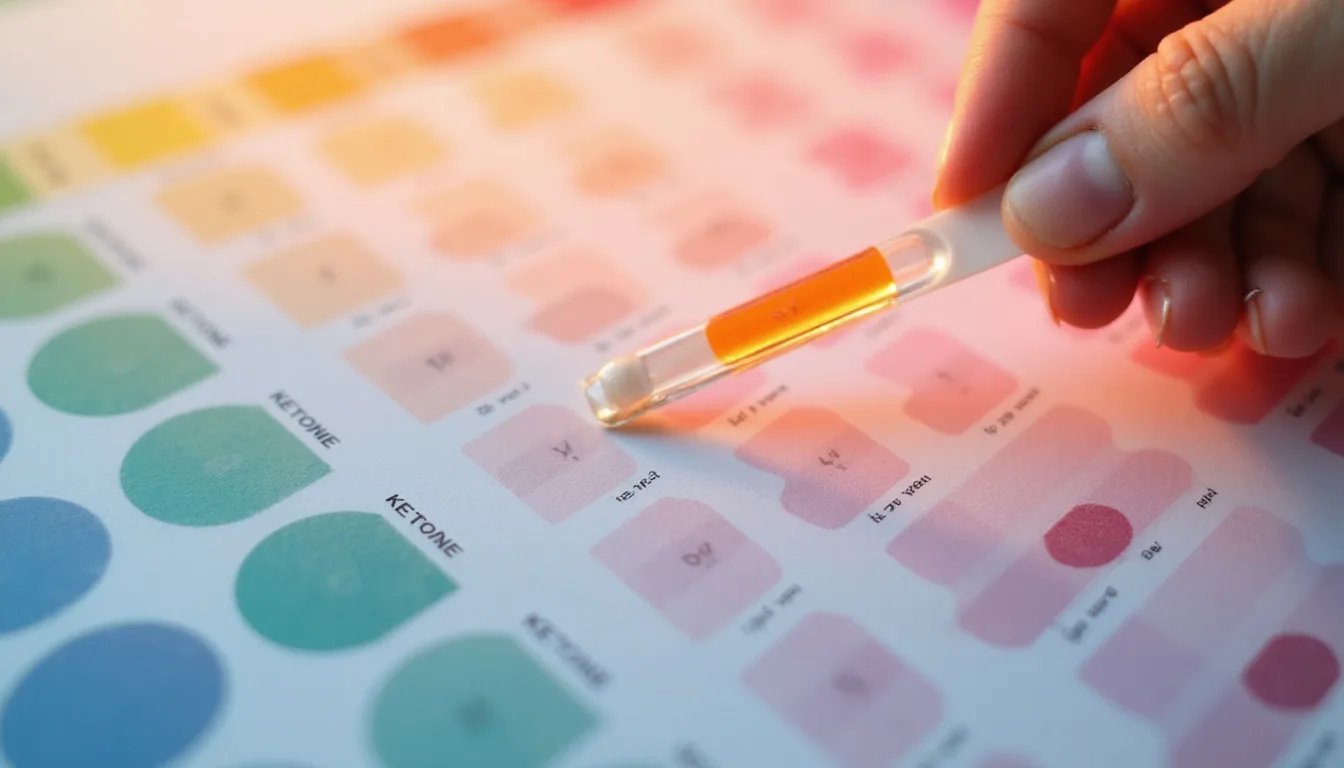
If you watch your carb intake, manage diabetes, or check your metabolic health, you may have seen ketone strips.
These simple strips help you find ketones in your body.
They work best if you use them right, read the colors close by, and know what can make them show false signals.
This guide shows all you need to know: what ketone strips measure, how to read them well, why they might show errors, and ways to get more solid test numbers.
What Are Ketone Strips and Why Do People Use Them?

Ketone strips are one-use test strips that detect ketone bodies in your body.
They work in these ways:
- Urine (most common and low cost)
- Blood (more exact and uses a meter)
- Breath (less common and uses a device)
Ketones are molecules made when your body burns fat instead of carbs.
This happens when you:
- Follow a very low-carb or ketogenic diet
- Fast or cut calories a lot
- Have uncontrolled diabetes or low insulin
- Face high physical stress (illness, infection, surgery)
Types of Ketones and What Strips Measure
Your body makes three main ketones:
- Acetoacetate (AcAc) – the main ketone found in urine
- Beta-hydroxybutyrate (BHB) – the main ketone found in blood
- Acetone – found in your breath
Most urine ketone strips measure acetoacetate.
This is good for home checks but may not match your real-time ketone state.
Urine vs Blood vs Breath Ketone Strips: Key Differences
Knowing how these tests differ helps you pick what fits your needs best.
Urine Ketone Strips
These paper or plastic strips have one small pad that reacts.
• Pros:
- Very low cost
- Easy to get from pharmacies and online
- Simple to use and read
• Cons:
- They show AcAc and not BHB (which is often more useful)
- They may lag behind real ketone levels
- They change with how much water you drink
- They can give false signals or strange colors as you adjust to ketosis
Good for: Beginners on keto, those who are curious, and rough checks instead of exact numbers.
Blood Ketone Strips
These strips use a small meter like a blood sugar tester.
• Pros:
- They measure BHB, the ketone that flows in the blood
- They give real and accurate results
- They help people with diabetes who need true numbers
• Cons:
- They cost more (for both the meter and the strips)
- They need a finger prick and blood drop
- Not everyone wants this detail level
Good for: People with diabetes at risk of ketoacidosis, medical checks, or serious keto dieters and athletes.
Breath Ketone Devices
These devices are not strips but tools that check acetone in your breath.
• Pros:
- No repeating strip costs
- They do not pierce the skin
- The device can be reused and is handy
• Cons:
- The start cost is high
- The numbers may seem less clear
- They are not as standard as blood tests
Good for: Those on keto who want a tool that does not need new strips each time.
How to Use Urine Ketone Strips Correctly
Many people use urine strips.
It is important to use the right method to get good data.
Step-by-Step Use
-
Check the date on the strip.
Old or poorly stored strips can show false signals. -
Get a fresh urine sample.
You can:- Let the strip touch your urine mid-stream, or
- Use a clean container to dip the strip.
-
Dip the strip into the urine.
See instructions for how long (usually 1–2 seconds). -
Remove extra urine.
Shake the strip gently. Do not wipe the pad with tissue or cloth. -
Wait the set time.
Most strips need 15–60 seconds. Follow the package directions. -
Compare the pad color with the provided chart.
Use a well-lit area and match the closest shade. -
Write down your result.
Record the time, reading, and details like your food, exercise, water intake, and any symptoms.
Best Time of Day to Test
• Morning (your first urine may have more ketones)
• Early to mid-evening can also give steady results.
Watch for trends over days or weeks and do not judge one single test.
How to Read Ketone Strip Results
Results are shown as:
- Negative
- Trace
- Small
- Moderate
- Large
Or as values like:
- 0 mg/dL – negative
- 5–15 mg/dL – trace
- 15–40 mg/dL – small
- 40–80 mg/dL – moderate
- 80–160+ mg/dL – large
Each brand may differ. Always use the strip’s own color chart.
Interpreting Results for Different Situations
For Keto Dieters
• Negative to Trace
Even these may occur if you use fat well.
Low ketones do not mean your diet fails.
• Small to Moderate
These often show in the early phase or during calorie cuts.
They are a sign that your body is using fat for fuel.
• Large
May happen when you are new to keto, during long fasting, or when you do not drink enough water.
In healthy people, large numbers without sickness are not usually a worry, but watch your water and how you feel.
For People With Diabetes
The numbers mean more when you have diabetes:
• Trace to Small
May appear with light fasting or low-carb eating.
If blood sugar is high, check for concerns.
• Moderate to Large
This calls for quick attention.
Look out for high blood sugar, nausea, vomiting, fast breathing, or confusion.
This mix of signs may show a rising diabetic ketoacidosis that needs urgent care (source: American Diabetes Association).
If you have diabetes, follow the advice of your medical team on testing and actions.
Common Causes of False Positives With Ketone Strips
False positives occur when the strip shows high ketones even if your body does not have them.
Watch for these factors:
1. Expired or Poorly Stored Strips
• Heat, wet air, or open storage can harm the chemicals on the strip.
• An open bottle may harm the strips before use.
• Keep them in a cool, dry space and close the bottle tightly.
2. Dehydration or Concentrated Urine
If you do not drink enough water, your urine is thicker.
This can:
• Make ketone numbers seem higher
• Turn the strip a darker shade
If you feel thirsty, have a dry mouth, or see dark urine, the reading may be affected by low water.
3. Some Medications or Substances
A few medicines or conditions can change urine or the strip’s action.
For example:
• Some water pills
• Some seizure medications
• Very high vitamin C (this can also lower the result sometimes)
Ask your pharmacist or doctor if you worry that a drug may alter your result.
4. Wrong Timing When Reading the Strip
If you:
• Read the strip too soon, it may show a lower result.
• Read it too late, the color may get darker.
Use a timer and follow the exact seconds in the instructions.
5. Contamination and Poor Technique
Contamination can come from:
• Soap or cleaning chemicals in your container
• Touching the test pad with your fingers
• Mixing with toilet water or other liquids
Always use a clean, dry container and hold the strip by the end that does not react.
Why Ketone Strip Results Change Over Time on Keto
Many people see high ketone numbers early on a ketogenic diet.
Later, the results may drop to trace or negative even if your diet stays the same.
This change comes from how your body adjusts:
Early Keto: Excess Ketones in Urine
In the first days of low-carb eating:
• Your body is not used to using ketones for fuel
• Extra acetoacetate leaves in the urine
• The strips show a dark color
Later Keto-Adaptation: Better Use of Ketones
After a few weeks:
• Your cells get better at using ketones
• Less acetoacetate leaks into urine
• The strip shows a lighter color even when your body still uses ketones well
This is why some long-time keto dieters choose blood tests for a steadier view.
How to Reduce False Positives and Get More Reliable Readings
Follow these steps to improve your ketone readings:
-
Use newer strips.
• Check the date on each strip.
• Discard any that look off before use. -
Keep them well stored.
• Seal the bottle tightly.
• Avoid places with high water vapor or big temperature changes.
• Do not move strips to other containers. -
Test in the same way each time.
• Pick nearly the same time every day.
• Do not test right after a big drink of water or fluids. -
Drink enough water.
• Aim for a pale yellow urine color.
• Test again if you think low water affected your reading. -
Follow the guide exactly.
• Dip the strip for the right time.
• Wait as long as told.
• Compare in good light. -
Look at your overall state.
• High ketones with good energy and clear thoughts may be normal.
• High ketones with high sugar, nausea, vomiting, or confusion need quick help, especially if you have diabetes. -
Check more than one test.
• Do not trust one result alone.
• Watch patterns together with your diet, exercise, mood, and blood sugar if needed.
When Should You Worry About Ketone Strip Results?
The worry level depends on your health.
If You Do Not Have Diabetes
- A few small or moderate numbers on a low-carb diet, during fasting, or after hard exercise are usually fine.
- Large numbers without other symptoms can be normal during fasting, yet check with a doctor if you feel unwell.
Call a doctor if you have high ketones along with:
• Long-lasting vomiting
• Abdominal pain
• Short breath
• Confusion or strong tiredness
• Fast, deep breaths
These signs may show serious problems even in those without diabetes.
If You Have Type 1 or Type 2 Diabetes
The numbers must be taken more seriously. Ask your healthcare team, but watch for:
• Moderate or large ketones with blood sugar above 250–300 mg/dL (13.9–16.7 mmol/L)
• Any ketones with nausea, vomiting, pain in your belly, or quick breathing
• Rising ketones even when you take your insulin as planned
These signs may point to diabetic ketoacidosis. This is an emergency that needs a quick check by a doctor.
A Simple Checklist for Smarter Ketone Strip Use
Use this quick guide to test smarter:
• Pick strips that are not past their date.
• Keep them cool, dry, and sealed.
• Test at a similar time of day.
• Drink enough water so you are not too dry or too full of water.
• Follow the package steps for timing.
• Read the result while you think of your diet, symptoms, and (if you have diabetes) blood sugar.
• If you do not understand the result or it worries you, talk with a doctor.
FAQ: Ketone Strip Results and Accuracy
1. How accurate are urine ketone strips compared to blood ketone tests?
Urine strips work well to show if ketones are present, especially early in ketosis or when checking for diabetic ketoacidosis.
They are not as good for:
• Giving a precise ketone number
• Working well for long-term keto users
• Cases when water intake changes the reading
Blood tests (measuring BHB) give a more exact and fast view of your ketone level.
When health care relies on ketone numbers (for example, in managing ketoacidosis or strict ketosis), blood testing is best.
2. Why do my keto test strips show negative even if I follow a ketogenic diet?
There are some reasons:
• You could be keto-adapted. Your body uses ketones well so fewer leak into urine.
• You may drink a lot of water, which dilutes urine.
• A small change in your carb or protein may lower ketone numbers even if you burn fat.
• The ketone strips might be old or have suffered from poor storage.
If you are losing weight and feel good and you stick to your plan, low or negative readings do not mean failure.
3. Can ketone testing strips be used every day and how often should I test?
Yes, you can test every day if you need to, especially in the early days of a ketogenic diet or for managing diabetes.
Many people test:
• Once each day at a set time
• More tests when you change your diet, fast, or feel off
Over time, you may test less often and focus on how you feel, your blood sugar (if needed), and other simple measures like body changes or performance.
Take Control of Your Ketone Monitoring
When used the right way, ketone strips are a strong, low-cost tool to see how your body handles low-carb eating, fasting, exercise, or other conditions.
Knowing how to read the results properly—and spotting when the strip might show a false or misleading result—turns guesswork into clear facts.
If you take keto eating, metabolic health, or safe diabetes control seriously, start by:
• Choosing the best testing type for your aims
• Following steps that cut down errors and false signs
• Watching trends over time instead of one test alone
If you need help setting up a clear plan for testing ketones along with your food, sugar checks, and lifestyle changes, now is a good time to speak with a healthcare or nutrition expert.
They can help you use these simple strips as a dependable tool in your health journey.
[center]Always consult with your doctor prior to making drastic diet changes.[/center]
[center]As an Amazon Affiliate, Savvy Keto makes a small commision (at no extra cost to you) on any purchases you make thru affiliated links you click on.[/center]